
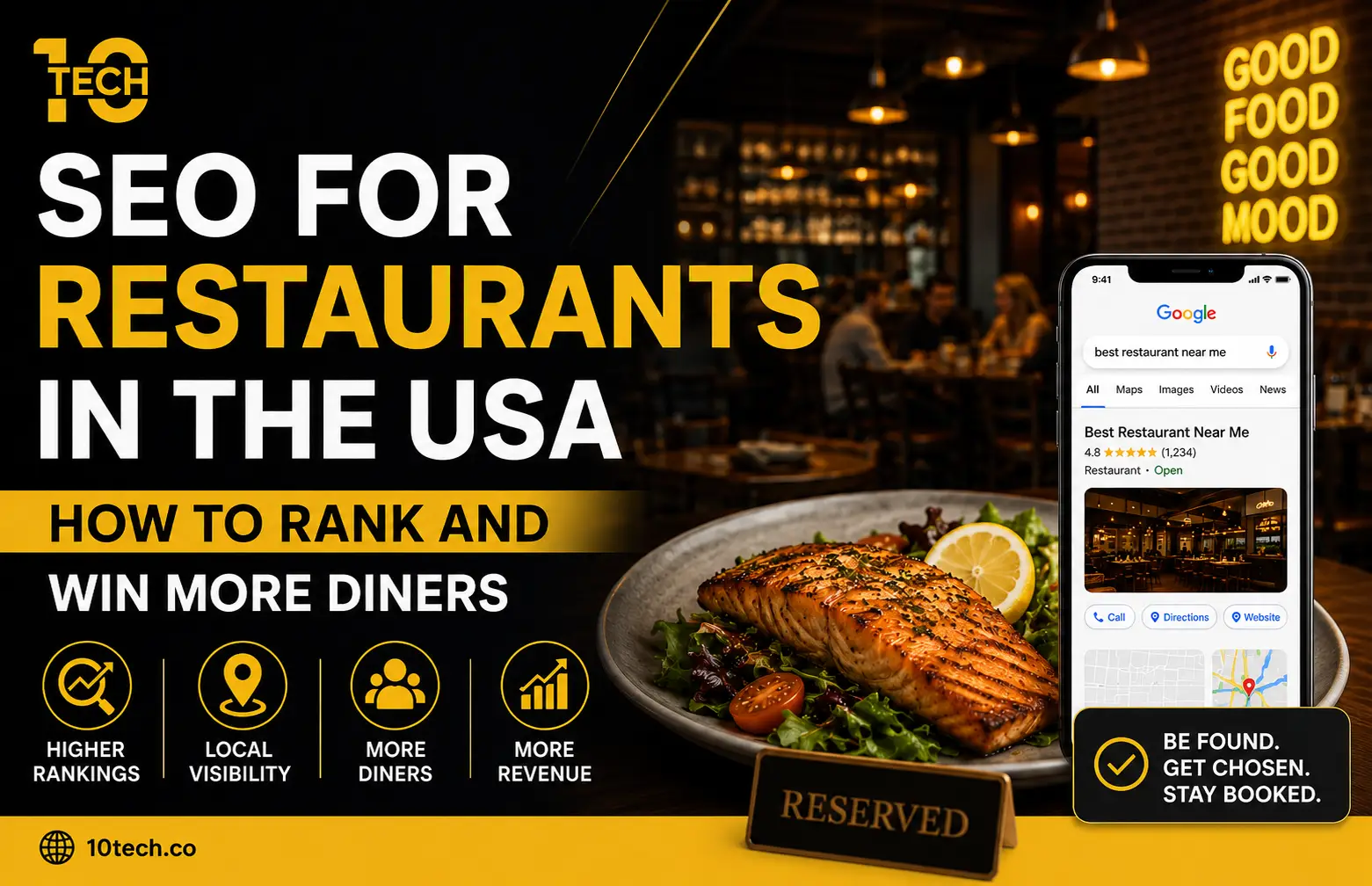
Restaurant SEO is about being visible at the exact moment someone nearby decides where to eat. That can mean appearing for searches such as “Italian restaurant near me,” “best brunch in Austin,” “halal restaurant in Chicago,” or even a specific dish such as “birria tacos near me.”
For restaurants in the United States, strong SEO goes beyond putting keywords on a website. It connects Google Business Profile, Maps visibility, menus, location pages, reviews, technical website performance, and useful content into one discoverable system.
A restaurant investing in SEO services for U.S. businesses should therefore measure success by more than rankings. The real objective is to turn local visibility into menu views, directions, calls, reservations, online orders, and ultimately paying guests.
What Is SEO for Restaurants?
Restaurant SEO is the process of improving a restaurant’s website and broader online presence so it can appear when potential diners search for relevant food, cuisine, dining experiences, dishes, or restaurants in a particular location.
For most restaurants, local SEO matters especially because Google knows restaurant searches often have geographic intent.
Google says local results are primarily influenced by three factors: relevance, distance, and prominence. Relevance concerns how closely a business matches the query, distance considers proximity to the searcher, and prominence reflects how well known or established the business appears online.
That means restaurant SEO should not be reduced to inserting “restaurant near me” throughout a website.
1. Make Google Business Profile Your Local Foundation
A restaurant should begin by claiming and verifying its Google Business Profile and keeping its core information accurate.
Google’s restaurant-specific Business Profile tools allow owners to manage information including addresses, telephone numbers, regular and special hours, dining attributes, menus, photos, ordering options, bookings, and customer reviews.
Check:
- Restaurant name
- Primary and secondary categories
- Address
- Phone number
- Opening hours
- Holiday hours
- Website
- Menu URL
- Reservation link
- Ordering provider
- Cuisine-related attributes
- Photos
The same basic local SEO principles that help other location-dependent businesses apply here: make it easy for search engines and customers to verify exactly what the business is, where it operates, and what it offers.
Accuracy matters more than stuffing descriptions with keywords.
2. Target the Way Diners Actually Search
Restaurant keyword research should combine food intent, location intent, and occasion intent.
Instead of targeting only:
restaurant in Dallas
a restaurant may have legitimate opportunities around searches such as:
- Italian restaurant in Dallas
- handmade pasta Dallas
- romantic Italian restaurant Dallas
- private dining Dallas
- gluten-free Italian restaurant Dallas
- Italian lunch downtown Dallas
Dish-level intent can also matter. If a restaurant is known for wood-fired pizza, lobster rolls, birria, ramen, omakase, or vegan desserts, those offerings should be represented in crawlable website content when they genuinely reflect the menu.
The goal is not to create hundreds of thin keyword pages. Build pages around real restaurant offerings and real customer decisions.
3. Make Your Menu Searchable, Not Just Attractive
One frequently overlooked restaurant SEO issue is the menu itself.
A beautifully designed PDF or image may be useful to customers, but important menu information should also exist as accessible HTML text whenever practical. Search engines need clear textual content to understand pages, and Google recommends making important content available in textual form.
A useful restaurant menu page can include:
- Menu categories
- Dish names
- Short descriptions
- Prices where appropriate
- Dietary options
- Cuisine type
- Relevant location information
- Clear reservation or order buttons
Strong professional web development becomes part of SEO here because customers should be able to move from search result to menu to reservation without fighting slow pages or confusing navigation.
Restaurant owners planning a redesign can also use this small-business web development guide as a broader checklist for usability and website structure.
4. Build Strong Location Pages for Multiple Restaurants
A restaurant group should not rely on one generic “Locations” page to rank every branch.
Create a dedicated, useful URL for each legitimate location.
For example:
/locations/austin-downtown/
A good location page can contain:
- Unique address and contact details
- Location-specific hours
- Relevant menu
- Reservation/order options
- Original photos
- Parking or accessibility details
- Neighborhood information
- Dining options
- Location-specific FAQs
Avoid producing dozens of near-identical pages with only the city name changed. Each location page should help a diner decide whether that specific restaurant meets their needs.
5. Treat Website SEO and Conversion as One System
Ranking a page is not enough if visitors cannot book.
For restaurant websites, SEO and conversion design should work together.
Make these actions obvious on mobile:
View Menu → Reserve a Table → Order Online → Call → Get Directions
Google recommends providing a good page experience and ensuring websites remain crawlable and understandable.
Restaurant content should also answer useful questions rather than simply repeating commercial keywords. SEO content creation can support searches around private dining, seasonal menus, dietary options, events, neighborhood guides, chef stories, and questions customers genuinely ask before visiting.
6. Build Reviews and Consistent Business Information
Reviews influence customer decisions and can contribute to local prominence. Google specifically says review quantity and positive ratings can help local ranking, while useful review responses can help a business stand out.
Restaurants should create a consistent process for requesting genuine reviews without manipulating ratings.
Respond to positive and negative feedback professionally.
At the same time, keep core information consistent across relevant platforms such as Google, Yelp, Apple Maps, reservation platforms, social profiles, and local directories.
Your social media marketing can support this broader discovery system by keeping current dishes, events, atmosphere, and customer-facing information visible beyond Google.
7. Use Restaurant Structured Data Correctly
Structured data can help Google understand explicit information about a local business.
Google supports LocalBusiness structured data and recommends using the most specific subtype possible. For restaurants, that can include the Restaurant type along with properties such as address, telephone number, cuisine, opening hours, price range, and menu URL.
But structured data should not be treated as a ranking shortcut.
And there is an important GEO distinction: Google does not require special AI schema to appear in AI Overviews or AI Mode. Its current documentation says normal Search technical requirements and established SEO best practices continue to apply. Structured data should accurately match the visible content on the page.
That is more credible than adding unsupported “AI schema hacks.”
8. Build a Brand Search Engines Can Verify
A restaurant’s name, cuisine, location, positioning, menu, and contact information should tell a consistent story across its website and major profiles.
That consistency supports both customers and machine understanding.
A deliberate branding strategy also helps restaurants present the same recognizable identity across their website, menu, social accounts, local profiles, and promotional material.
Visual content matters as well, although images should support—not replace—useful textual information. Restaurant operators that need stronger menu, social, or branded visual assets can connect this work with professional graphic design services.
For GEO, the goal is not to repeatedly tell AI systems that you are “the best restaurant.” Build enough consistent, factual information around the restaurant that search systems can accurately understand what it is and who it serves.
9. Measure Restaurant SEO by Business Actions
Restaurant SEO reporting should go beyond keyword rankings.
Google Business Profile provides restaurant-relevant performance information including queries used to find the business, menu interactions, and bookings.
Combine that with Search Console and analytics to monitor:
- Organic impressions
- Organic clicks
- Non-branded search queries
- Location-page performance
- Menu visits
- Reservation actions
- Order clicks
- Calls
- Direction requests
- Conversion rate
A ranking increase is useful only when it moves the business toward a measurable outcome.
For restaurants needing demand immediately while organic visibility develops, SEO can also work alongside PPC management. Paid search can capture short-term high-intent demand while SEO builds longer-term organic visibility.
Frequently Asked Questions
Is SEO worth it for restaurants?
Yes, when the restaurant has meaningful search demand in its geographic market. SEO is particularly relevant for restaurants because diners frequently search by cuisine, dish, neighborhood, occasion, and proximity. The strategy should prioritize bookings, orders, calls, directions, and qualified visibility rather than chasing traffic with no connection to the restaurant’s service area.
How can a restaurant rank higher on Google Maps?
Start with a verified and complete Google Business Profile, accurate hours and contact information, relevant business categories, authentic reviews, useful photos, consistent business information, and a website that clearly reflects the restaurant’s offerings and location. Google’s documented local-ranking framework is relevance, distance, and prominence.
Do restaurants need blogs for SEO?
Not necessarily. A small restaurant should first get its homepage, menu, location information, Business Profile, and conversion paths right. Blogging becomes valuable when the restaurant can publish genuinely useful content around private dining, events, cuisine, neighborhoods, dietary needs, signature dishes, chef expertise, or other topics customers actually search for.
Does schema help a restaurant appear in AI search?
Structured data helps search engines understand explicit business information, but it should not be treated as a guaranteed AI-visibility tactic. Google currently says there is no special schema required for AI Overviews or AI Mode. Strong foundational SEO, crawlable content, accurate Business Profile information, internal links, and structured data that matches visible content remain the recommended approach.
How long does restaurant SEO take?
There is no universal timetable. Progress depends on the restaurant’s location, competition, existing authority, website condition, review profile, technical issues, and whether the business is starting from scratch. Track early improvements in visibility and engagement, but evaluate the campaign over time using reservations, orders, calls, directions, and other business outcomes—not rankings alone.
Turn Restaurant Searches Into Real Customers
The strongest restaurant SEO strategy connects local visibility with the complete diner journey.
That means accurate Google information, searchable menus, location-relevant pages, genuine reviews, useful content, clear structured data, a technically sound website, and easy paths to reserve or order.
For independent restaurants, start with the fundamentals before investing in dozens of content pages. For multi-location brands, build a scalable structure that gives every location its own accurate and useful search presence.
If your restaurant is visible online but not turning searchers into bookings, orders, or visits, talk with 10Tech about building an SEO strategy around both discoverability and conversion.